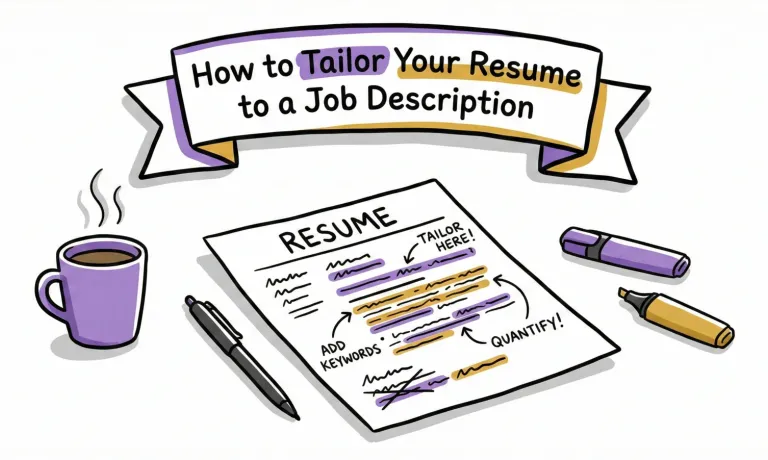
A good resume bullet replaces a general claim with specific details about your work. Say what you did, what you worked on, and how you did it. Those details help an employer recognize experience relevant to their job.
For an illustrative example, suppose you compared weekly sales by store in Excel and sent the purchasing team a list of products with falling sales. Instead of:
Analyzed data to support business decisions.
Write:
Compared weekly store sales in Excel and flagged products with falling sales to the purchasing team.
The second version names the data, the tool, and what you did with the findings. An employer looking for sales reporting experience can see the connection immediately.
We recommend using Reztune's resume tailoring to do this for each application. Add your background and the job posting; Reztune identifies the relevant requirements and keywords, then rewrites your bullets and other sections around the work this employer needs. You review the result and stay in control of the facts.
12 resume bullet point examples, with the facts behind them
The backgrounds, job requirements, and rewrites below are illustrative. They are not customer resumes or captured Reztune outputs. The improved versions use the stated background facts, including details that the weak versions left out. Use the examples as patterns for explaining your own work.
Customer support
What the target job needs: account troubleshooting and clear handoffs to engineering.
Source facts: This support specialist answered subscription-billing and login questions through email and chat in Zendesk. They corrected billing details after checking account records. For software errors they could not resolve, they recorded the steps that triggered the error and attached screenshots to engineering tickets. Engineers handled the software fixes.
1. Explain the support you provided
Weak:
Delivered excellent customer service.
Clearer:
Resolved subscription-billing questions by checking account records and correcting billing details in Zendesk.
This names the problem and how the candidate handled it. The employer can assess the overlap with their support work.
2. Describe your part in a handoff
Weak:
Worked with engineering on technical issues.
Clearer:
Recorded steps to reproduce software errors and attached screenshots to tickets for engineering.
The contribution is clear. There is no claim that the support specialist fixed the software.
Administration
What the target job needs: meeting coordination and invoice records.
Source facts: This administrative assistant scheduled weekly meetings for a six-person team using shared Outlook calendars. They sent agendas supplied by the team lead. They also entered supplier invoices in Excel and flagged missing purchase-order numbers to the office manager. They did not approve payments or manage the budget.
3. Make coordination specific
Weak:
Supported a busy team with scheduling.
Clearer:
Scheduled weekly meetings for a six-person team in Outlook and sent agendas prepared by the team lead.
The team size gives useful scope. The wording also keeps preparing an agenda separate from distributing it.
4. Show how you handled records
Weak:
Managed financial administration.
Clearer:
Entered supplier invoices in Excel and flagged missing purchase-order numbers to the office manager.
This explains the task more accurately than a broad financial label. It does not imply accounting responsibility or payment approval.
Retail and operations
What the target job needs: stock handling, customer assistance, and following store procedures.
Source facts: This retail associate unpacked deliveries, checked quantities against delivery notes, and restocked shelves. They helped customers find products and showed two new coworkers how to check shelf labels and report damaged stock using the store's checklist. They did not supervise those coworkers or measure sales changes.
5. Name the practical work
Weak:
Helped with stock and store operations.
Clearer:
Checked incoming stock against delivery notes, restocked shelves, and helped customers locate products.
The employer can recognize the work immediately. A sales-growth claim would not explain these responsibilities any better.
6. Describe training without inventing management experience
Weak:
Demonstrated leadership and teamwork.
Clearer:
Showed two new coworkers how to check shelf labels and report damaged stock using the store checklist.
This gives concrete evidence of helping others learn a procedure. It does not turn the candidate into a team manager.
Marketing
What the target job needs: preparing email campaigns and maintaining accurate website content.
Source facts: This marketing coordinator built four webinar emails in Mailchimp using copy supplied by the marketing manager. They checked links and scheduled the sends. They also updated eight product help articles after a software release, replacing outdated screenshots and instructions. They did not own campaign strategy, and no registration or customer-support results were measured.
7. Explain your campaign contribution
Weak:
Drove successful email marketing campaigns.
Clearer:
Built and scheduled four webinar emails in Mailchimp using supplied copy, checking links before each send.
This tells the employer what the candidate can do in the platform. The email count shows the assignment's size without implying a business result.
8. Show what changed in the content
Weak:
Optimized content to improve the customer experience.
Clearer:
Updated eight product help articles after a software release, replacing outdated screenshots and instructions.
The change is visible in the sentence. There is no need to claim fewer support requests when that was not measured.
Software and data
What the target jobs need: a backend engineer who can work on APIs and tests, or a reporting analyst who can prepare recurring reports. These are separate candidates.
Source facts: The engineer added a delivery-status field to an existing Java/Spring Boot API and wrote JUnit tests for present and missing values. A senior engineer designed the API. Separately, the analyst combined weekly sales CSV files and checked duplicate order IDs manually. They wrote a Python script to perform those steps. Timing the same preparation task over three weekly runs before and three after showed a reduction from 45 to 15 minutes per run. The analyst still reviewed the prepared file before reporting.
9. State the technical contribution clearly
Weak:
Architected robust backend solutions.
Clearer:
Added a delivery-status field to a Java/Spring Boot API and wrote JUnit tests for present and missing values.
This gives a technical reviewer useful detail while making the work understandable to someone screening for Java and testing experience. It does not claim ownership of the API's design.
10. Use a result when the evidence supports it
Weak:
Used Python to improve reporting efficiency.
Clearer:
Wrote a Python script to combine weekly sales CSVs and check duplicate order IDs, reducing file preparation from 45 to 15 minutes per run.
Here the before-and-after timings support the result. The claim stays limited to file preparation; the script did not automate every reporting task or remove the need for review.
Student projects and volunteering
What the target jobs need: basic spreadsheet work for a junior reporting role, or visitor assistance for an entry-level service role. These examples also describe separate people.
Source facts: In an individual class project, the student cleaned duplicate rows in a sample survey dataset using Excel and made PivotTables to summarize responses by age group. At a community center, the volunteer checked visitors against a registration list and directed them to their booked activity rooms. Neither activity was paid employment.
11. Describe a project in its actual setting
Weak:
Developed advanced analytical capabilities.
Clearer:
Removed duplicate rows from a sample survey dataset in Excel and built PivotTables to summarize responses by age group.
Under an academic-project heading, this shows specific spreadsheet experience without claiming professional analyst work.
12. Give ordinary responsibilities enough detail
Weak:
Helped at a community center.
Clearer:
Checked visitors against the registration list and directed them to their booked activity rooms.
Under a volunteer heading, this demonstrates record checking and visitor assistance. It does not need a made-up satisfaction score. For help assembling the whole document, see our guide to writing a resume with no experience.
How to write your own resume bullet points
Start with what this employer needs
Read the responsibilities in the actual posting before choosing your examples. A support job focused on troubleshooting needs different evidence from one focused on maintaining help articles, even if the titles look similar.
Pick the main tasks and find work you have done that supports them. Our guide to finding keywords in a job description explains how to identify the terms that describe those requirements. Use those terms when they accurately name your experience.
Collect facts before rewriting
For each relevant task, jot down:
- What you personally did.
- The tool, process, or method you used.
- Who or what you worked with.
- Any known scope, frequency, deliverable, or result.
You do not need an answer in every category. The point is to supply enough information for a clear sentence. If you worked on a team, separate your contribution from the team's combined result.
These notes are also useful input for Reztune. A base resume that says only “handled reports” leaves important work unstated. Add what the reports contained, how you prepared them, and what you checked so that the tailoring has real evidence to work with.
Write the action and the useful detail
A practical starting structure is what you did + what you worked on + a relevant detail. Include an outcome when it adds useful, supported information.
Choose the verb that describes the action: wrote, checked, scheduled, repaired, answered, tested, or trained. “Spearheaded” does not improve a sentence if the work was scheduling a meeting.
Keep terminology the employer needs. Java, purchase orders, or Zendesk may be important signals. Expand an internal acronym or replace a company-specific label if an outside reader would not know what it means. The aim is for both a recruiter and someone who does the work to understand your contribution quickly.
Read it as an employer
Ask: Could someone tell what I actually did after reading this once?
If the sentence could describe almost any job, add the missing task or context. If it is crowded with abstract phrases, use the words you would use to explain the work in a conversation. Remove claims such as “excellent communicator” when the activity itself provides better evidence.
Check that the bullet agrees with the rest of the resume. A skills section naming a tool should have a real basis in your work or projects. Our resume skills section examples show how to select and group those abilities.
What if you do not have numbers or measurable results?
Describe the work clearly. Many useful responsibilities do not come with a measured revenue increase or time saving. Checking an invoice, documenting an error, or explaining a process can demonstrate relevant ability on its own.
Use numbers when you know them and they help someone understand the work. “Weekly meetings for a six-person team” describes frequency and scope. “Reduced preparation from 45 to 15 minutes” describes a measured change. Both can be useful, but they answer different questions.
Do not replace an unknown result with a guess. If nobody measured whether updated help articles reduced support tickets, explain what you updated. Likewise, “to help visitors find their rooms” describes a purpose; “reduced visitor waiting time” claims an outcome that needs evidence.
If your contribution supported a larger team result, state your part accurately. Building the emails does not make you solely responsible for every webinar registration. Clear, bounded responsibility is easier to discuss in an interview than an inflated achievement.
The same experience, tailored to two job postings
Consider another illustrative candidate, Alex Rivera, a Customer Support Specialist at the fictional Harborline Software from March 2024 to September 2026.
Alex's source facts: Alex handled subscription-billing and login questions through email and chat in Zendesk, checked account records, and corrected billing details. For unresolved software errors, Alex recorded reproduction steps, attached screenshots, and sent tickets to engineering. Alex also wrote help-center articles about recurring billing and login questions and updated them after engineers confirmed a fix. Each Friday, Alex exported Zendesk ticket data to Excel, grouped tickets by issue type, and sent the support lead a summary of recurring problems. Alex has not used Salesforce or built automated reporting dashboards.
Posting A: customer support specialist
This job emphasizes email/chat support, account troubleshooting, and useful engineering handoffs. Zendesk experience is requested; Salesforce experience is preferred.
Alex could use:
Customer Support Specialist | Harborline Software | March 2024–September 2026
- Answered subscription-billing and login questions through email and chat in Zendesk, correcting billing details after checking account records.
- Documented reproduction steps and screenshots for unresolved software errors before sending tickets to engineering.
- Wrote help-center articles explaining how to resolve recurring billing and login questions.
The direct support work comes first. Documentation supports the same case, while the weekly Excel summary receives less space. Salesforce stays out because Alex has not used it.
Posting B: support operations and documentation specialist
This job emphasizes maintaining help content, summarizing recurring issues, and keeping engineering handoffs clear. It asks for Zendesk and Excel experience; automated dashboard development is preferred.
The same experience could become:
Customer Support Specialist | Harborline Software | March 2024–September 2026
- Wrote help-center articles about recurring billing and login questions and updated them after engineering confirmed fixes.
- Grouped weekly Zendesk ticket exports by issue type in Excel and sent the support lead a summary of recurring problems.
- Recorded reproduction steps and attached screenshots to software-error tickets sent to engineering.
The title, dates, tools, and responsibilities stay true. The second version brings documentation and reporting forward because that is what this employer needs. It leaves out some direct-service detail to give the relevant work room.
Alex's Excel summaries support reporting experience, but they do not establish automated dashboard development. That remains a gap to assess against the posting. Tailoring makes the overlap clear enough to evaluate; it does not supply experience the candidate lacks.
Use Reztune to tailor the bullets within your whole resume
Alex's example involves more than choosing better verbs. You have to understand the posting, find the right evidence, decide what deserves space, and make the bullets agree with your summary and skills. Then another job appears with different priorities.
Our recommendation is to use Reztune for that repeated work. It makes tailoring each application practical while keeping the candidate's actual experience at the center.
Add your background and the job description
Upload your base resume, or create one in the editor. Include the facts behind your responsibilities and achievements, even when your current wording is rough. Paste the actual posting for the job you want.
Reztune analyzes the employer's requirements, matches important keywords to your experience, and rewrites the relevant sections together. For a candidate like Alex, that means explaining troubleshooting for one role and bringing documentation and reporting forward for another. The summary and skills can support the same emphasis instead of describing a different candidate from the bullets below them.
This is why the product goes beyond generating a polished sentence. It connects your real background to the work in this particular posting and carries that context through the application.
Review the evidence and the wording
Use the requirement analysis to see what appears met, partially met, or missing. If you have done something but left it out of the base resume, add the true details. If you have related experience, keep its scope clear. If you have never used the requested tool, a stronger sentence cannot change that.
Reztune's match score summarizes alignment with the posting. It is not the employer's ATS score or your probability of an interview. The useful part is seeing which requirements your experience supports and what needs attention.
Read the rewritten bullets with the same plain-language test: can the employer quickly understand what you did? Edit anything that needs clarification, and accept suggested additions only when they are true. Reviewing the requirements can also help you recognize experience you had overlooked and see which skills recur across the jobs you want.
Prepare the document and keep the application together
Choose a professional template and review the finished resume. Reztune handles the layout as the content changes, so you do not have to rebuild spacing and page breaks for every application. Follow any file-format instructions from the employer.
The free tier includes three tailoring credits per month. One credit generates a tailored resume and a job-specific cover letter; both are editable. Generation and viewing are free. Downloading the formatted resume PDF requires payment.
Reztune's application tracker keeps the matched job, resume version, status, and notes together. You can see what you sent and return to the right context when an employer responds.
That connected workflow saves the repeated analysis, rewriting, formatting, and file management behind each application. You can focus on choosing suitable jobs, reviewing your fit, and applying promptly, with a clear account of your experience for each employer.
Bullet length, count, tense, and punctuation
- Length: Aim for one sentence that is easy to scan, often one or two lines in the finished layout. Cut repetition before shrinking the font. Split a bullet if it combines unrelated work.
- Count: Three to five useful bullets can be a starting point for a recent, relevant role. Give older or less relevant roles less space. Keep the evidence the employer needs rather than filling a quota.
- Order: Put the strongest evidence for this posting first. Different applications may need a different order, as Alex's examples show.
- Tense: Use present tense for ongoing responsibilities and past tense for completed work. A current job can include past tense for a finished project.
- Punctuation: Use the same style throughout. Periods work well for the complete statements in these examples.
- Format: Use simple bullets and clear job headings. Check the exported document to make sure the text, dates, and page breaks remain readable.
These are writing and layout choices, not a scoring formula. The employer should be able to find and understand the relevant work quickly.
Check your bullets before applying
- Can someone understand what you actually did after one reading?
- Does each bullet contribute evidence relevant to this job?
- Are the tools, responsibilities, and level of ownership accurate?
- Can you explain where every number and result came from?
- Are projects, volunteering, and paid employment labeled correctly?
- Do the summary and skills agree with the experience?
- Have you checked the final layout and selected the version for this employer?
Your experience does not need elaborate language to have value. Give it enough detail to be understood, choose what matters to the opening, and keep the wording plain.
Use Reztune to tailor your resume for each job and make that approach repeatable. It handles the comparison, rewriting, formatting, and organization so you can review a relevant application and move forward.