

Quick Verdict: Which AI Is Best for Your Resume?
If you only want the answer: Claude is the strongest of the three for resume writing and tailoring. In an expert test by Tom's Guide, Claude was the clear winner, achieving the best balance of ATS optimization with human-readable, impactful writing. It also lets you upload your actual resume file, so it can catch formatting problems the other two never see. ChatGPT is the best brainstorming partner, and Gemini is the most research-driven, but both fall behind Claude on the writing itself.
The bigger catch applies to all three. Even the best generalist AI only produces raw text. It will not format an ATS-safe document for you, it will not stop you from pasting that text into a layout that breaks, and it will not track where you applied. Those gaps are exactly what a dedicated tool for AI resume tailoring is built to close. Here is the full comparison, then the deep dive on each.
At a Glance: Claude vs ChatGPT vs Gemini
| ChatGPT | Gemini | Claude | |
|---|---|---|---|
| Tailoring quality | Strong rewriting, but default output sounds generic | Good keyword integration, less engaging prose | Best balance of tone and ATS optimization |
| ATS / formatting | None. Raw text only | None. Raw text only | None, but can spot broken PDF code in an uploaded file |
| Hallucination risk | High. Known to invent skills and certifications | Present, like all generic AI | Present, but document-grounded review helps |
| Document upload | No. Copy-paste only | No. Copy-paste only | Yes. Upload resume and JD as files |
| Best for | Brainstorming and rewriting bullet points | Research-driven, concise summaries | Overall resume writing and tailoring |
How We Compared the Big 3
In the modern job search, your resume isn't just a document; it's a key. It's the first, and often only, thing that stands between you and an interview, and it's almost always read first by a machine: an Applicant Tracking System (ATS).
Into this high-stakes, high-rejection environment, generative AI tools like ChatGPT arrived like a magic wand. Suddenly, the grueling, time-consuming task of tailoring a resume for every single job application seemed to vanish. The promise was intoxicating: an optimized resume in less than 3 minutes, perfectly customized to any job description. Job seekers, understandably, dived in, using AI to draft resumes, tailor bullet points, and craft custom summaries.
But a paradox has emerged. The secret edge that was supposed to make you stand out is now the very thing making you blend in. In 2023, using ChatGPT for your resume was a clever hack. In 2025, it's just part of the noise. Recruiters and hiring managers are now drowning in a sea of near-identical, low-effort applications. The GPT resume has become a tell. One hiring manager, in a now-infamous Reddit post, reported that over 35% of their applicants had submitted the exact same free ChatGPT answer to their screening questions.
Recruiters, overwhelmed by this flood, are now actively filtering out applications that feel AI-generated. So the question every job seeker must ask is no longer "should I use AI," but "which AI, and how do I use it without getting sorted into the reject pile?" To tailor a resume effectively, an AI must do more than rewrite text; it must understand context, mimic a professional tone, integrate specific keywords, and, most importantly, not invent facts. We analyzed the workflow, strengths, and weaknesses of ChatGPT, Google Gemini, and Anthropic's Claude for exactly that task.
ChatGPT for Resumes: The Brainstorming Buddy
ChatGPT, the tool that started the revolution, is often the first stop for job seekers. But the reality of using ChatGPT for resume tailoring is a far cry from a one-click solution. It's a do-it-yourself project that requires you to become a prompt engineer.
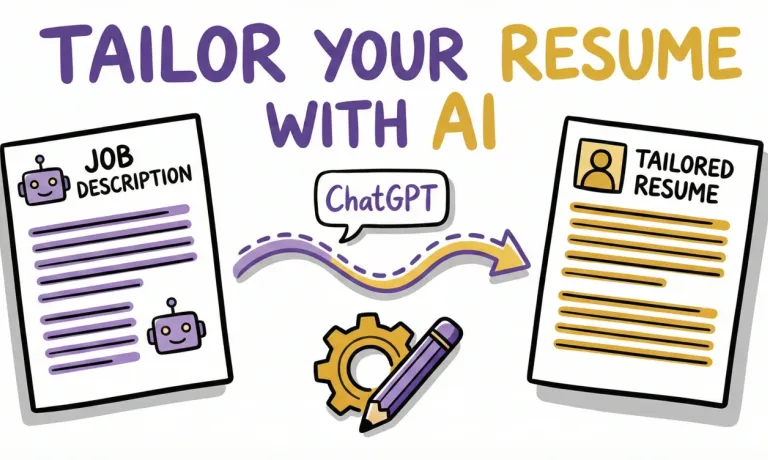
The process is entirely manual and multi-stepped. You prime the AI with a role prompt ("Act as an experienced resume writer and career expert"). You copy and paste the entire job description into the chat. You then paste the entire text of your resume below it. You can't just say "fix it," so you give specific, section-by-section instructions like "Rewrite my work experience bullet points to include these keywords." Best practice involves generating multiple versions and manually sifting through them to assemble the best parts yourself.
Where ChatGPT is strong:
- Brainstorming. It is an excellent partner for getting ideas flowing.
- Drafting and rewriting. It is very strong at taking your existing bullet points and rewriting them to sound more impactful, often suggesting stronger action verbs.
- Keyword identification. It can scan a job description and help you identify key skills and terms you may have missed.
Where ChatGPT falls short:
- Generic output. Its default writing often sounds generic or inaccurate. Hiring managers are now so attuned to this that they can easily spot the robotic, vague language.
- Hallucination. This is ChatGPT's most dangerous flaw. It will confidently give you incorrect information, and Reddit threads are filled with users annoyed that it invents skills and experiences they don't have. One hiring coach, testing the tool, was horrified when it added certifications she did not possess.
- No formatting. ChatGPT is a text generator, not a document formatter. It provides zero guidance on layout, font choices, or visual presentation, all of which are critical for passing an ATS.
Gemini for Resumes: The Research-Driven Option
Google's Gemini, integrated deeply into Google Workspace, positions itself as the research-savvy, data-driven alternative - see our full Gemini for resume writing guide. The workflow is similar to ChatGPT's: a manual process often run inside a Google Doc, where you paste your resume and the target job description and prompt it to convey your achievements in practical language for the role.
Where Gemini is strong:
- Research and data. This is Gemini's core advantage. It has access to recent job market trends and emerging skill requirements, making its suggestions contextually relevant.
- Contextual optimization. It excels at integrating keywords naturally within readable content, rather than just stuffing them in.
- Concise summaries. Users find its style concise and to-the-point, which can be effective for professional summaries.
Where Gemini falls short:
- Limited creativity. Its strengths are research and informational tasks, not imaginative or human-like prose. Its writing is often rated as less engaging than ChatGPT's.
- Text-only. Like its competitors, it's a text-generation tool, not efficient for the full, text-heavy task of building a resume from scratch.
- Ranked behind the others. In many head-to-head comparisons by users, Gemini is often ranked behind both Claude and ChatGPT for the creative and professional writing tasks that are the essence of a good resume.
Claude for Resumes: The Pro's Choice
Claude has quickly become the pro's choice for many text-based professional tasks, and for good reason. It offers a fundamentally different and superior workflow. Claude's large context window (up to 1 million tokens) is its killer feature. Instead of the copy-paste shuffle, Claude lets you upload documents. You start a chat, upload your resume as a PDF and the job description as a PDF or text file, and prompt it to analyze the job description and incorporate the most important details into your resume.
Where Claude is strong:
- The winner on quality. In an expert test by Tom's Guide, Claude was the clear winner for resume writing. It achieved the best balance of ATS optimization with human-readable, impactful writing.
- Superior tone. Its output is consistently praised for its nuanced understanding of professional tone. It sounds less like a robot and more like a professional human.
- Document-aware analysis. This is Claude's most significant advantage. Because it can analyze the document file itself, it can spot problems no other generic AI can. One user reported that Claude pointed out the underlying code of their PDF resume was messy and unreadable to an ATS, an insight that could save someone from months of automatic rejections they would never be able to diagnose.
Where Claude falls short:
- Still a DIY tool. Despite its sophistication, Claude is an assistant, not a solution. You must still manually review and refine its output and, critically, transfer that text into a new, safe template.
- Clinical tone. That professional tone can sometimes feel clinical or overly formal, depending on the industry.
- Built as a collaborator. Anthropic's own guidance for job applicants states: "Please create your first draft yourself, then use Claude to refine it." It is designed to be a collaborator, not a done-for-you button.
The evolution from ChatGPT's clunky copy-paste to Claude's document upload reveals the real story: the market is moving away from basic chat interfaces and toward integrated, document-aware platforms. The Big 3 are catching on to a problem that specialized tools already solved.
The 4 Hidden Pain Points of a DIY AI Resume
The weaknesses above are not minor inconveniences. In a competitive market, they are application-killing failures.
Pain Point #1: Formatting and the ATS Black Hole
This is the single biggest reason for rejection. Generic AIs only produce raw text. They do not produce a formatted, ATS-compliant document. You are forced to paste that text into a generic template in Word or Google Docs, and this is where everything breaks. In an attempt to make a targeted resume that looks creative, job seekers make fatal formatting mistakes: messy layouts with inconsistent fonts and margins, ATS-breaking elements like tables, text boxes, columns, or graphics whose text is invisible to the scanner, and wrong file formats like image-based PDFs. The irony is devastating. You use AI to beat the ATS, but the manual copy-paste-and-format step is what causes your resume to be instantly rejected.
Pain Point #2: Hallucination and the Liar Label
AI models hallucinate; they invent plausible-sounding facts. In resume writing, that's critical. AIs will add skills, experiences, and even certifications you do not have. Recruiters will fact-check your resume against your LinkedIn or background, and when they ask you to elaborate on a hallucinated project in the interview, you are instantly exposed as either a liar or dangerously incompetent. This means you must forensically proofread every single line the AI generates, which adds significant work and risk.
Pain Point #3: The Generic-ification of Your Career
The most human part of your resume, your unique voice and achievements, is the first thing generic AI scrubs away. This is not just an aesthetic problem; it's a scoring problem. A recruiter explicitly confirmed that they score AI applications down, because the AI-generated text is based off the job description and generally not the essential criteria associated with the advert. This is the lose-lose paradox: you keyword-stuff to pass the ATS, but the resulting text is so bland it fails the human review because it doesn't highlight the actual achievements the recruiter is scoring.
Pain Point #4: The Manual Labor Loop
The 3-minute resume is a myth. The actual workflow is a tedious loop that creates more work, not less: 15 minutes writing a complex prompt, the copy-paste shuffle between your old resume and the JD and the chat window, forensic editing for hallucinations, and complete re-formatting in Microsoft Word. The AI doesn't save time; it shifts it. A hiring coach who tested ChatGPT for her own resume found it would have taken more time to edit the flawed output than to write it from scratch.
Generic AI vs. Specialized Resume Platforms
The gap left by generic AIs, their inability to handle formatting, manage applications, or guarantee accuracy, has created a category of specialized AI resume platforms. These tools (like Rezi, Teal, Huntr, and Reztune) are not just text generators; they are integrated systems built for ATS success, with ATS-optimized templates, AI keyword targeting against the job description, automated one-click tailoring within the document, and real-time match scoring. This table shows the gap they fill.
| Feature | Generic AI (ChatGPT, Gemini, Claude) | Specialized AI Platforms |
|---|---|---|
| Relevant content generation | Yes, but requires heavy prompting and manual verification | Yes, specialized in resume optimization |
| ATS-optimized templates | None. User must find and format manually | Yes. Guaranteed ATS-compliant |
| Formatting and layout | None. Breaks ATS rules | Yes. Fully automated |
| One-click tailoring | None. Manual multi-step loop | Yes. Replaces the manual process |
| Job-specific keyword analysis | Possible, but often generic and can hallucinate | Yes. Real-time match scores against the JD |
| Application tracking | None. It's a chat tool, not a project tool | Yes. Integrated to manage the job hunt |
| Interview preparation | Possible, in a separate chat | Yes. Integrated and based on the JD |
How Reztune Closes the Gap
The pain points above are why a platform like Reztune's AI powered resume builder exists. Rather than handing you raw text, it tailors your existing, verified resume inside ATS-safe templates, so the formatting and hallucination traps are designed out from the start. You build a career profile once, paste in a job description, and get a tailored, formatted resume in a single step, then track where you applied and prep for the interview using the same job description. If your bottleneck is the endless manual loop, that is the part it removes.
Expert Prompts for a Better DIY Resume
If you're committed to the DIY route, the right prompts are what separate a generic draft from a usable one. Adapt these, and always combine them with your resume and the target job description.
1. For a Powerful Professional Summary
Act as a professional resume writer. Based on the attached resume and the provided job description for the Job Title role, write a 3-4 sentence professional summary. The summary must:
- Start with my years of experience and core expertise in Your Industry/Field.
- Incorporate the following keywords from the job description: Keyword 1, Keyword 2, Keyword 3.
- Highlight my single most impressive and quantifiable achievement that aligns with the role's primary goal.
- Maintain a professional and confident tone. Do not invent any skills or experiences.
2. For Rewriting Bullet Points with the STAR Method
Analyze the 'Work Experience' section of my attached resume. Rewrite the following bullet point using the STAR (Situation, Task, Action, Result) method to make it more impactful: 'Paste your original bullet point here.'
Now cross-reference it with the attached job description and enhance the rewritten bullet point to include relevant skills and keywords. The final output should be a single, powerful bullet point that is concise, action-oriented, and demonstrates a clear, quantifiable achievement relevant to the target job.
3. For Identifying and Integrating Keywords
I am tailoring my resume for a Job Title position. Please act as an ATS analysis expert.
- Scan the attached job description and extract the top 10 most important keywords and skills for this role.
- Scan my attached resume.
- Create a table with two columns. In the first, list the keywords from the job description. In the second, indicate whether that keyword is present in my resume ('Yes' or 'No').
- For any missing keywords, suggest 2-3 natural-sounding ways I could incorporate them into my 'Work Experience' or 'Skills' sections without just listing them.
4. For Creating a Targeted Resume from Scratch
Act as a resume writing expert. Help me craft a resume for the Job Title position based on the attached job description. Using the information from my background below, generate a complete, ATS-friendly resume.
My Background: Paste your raw career information: past job titles, companies, dates, key responsibilities, and skills.
Instructions:
- Create a professional summary, a skills section, a work experience section, and an education section.
- Tailor the content of each section to be highly relevant to the attached job description.
- Use strong action verbs and quantify achievements wherever possible.
- Highlight the skills and experiences that match the job requirements.
- Output text-only, formatted clearly for me to copy into a resume template.
These prompts force the AI to be more specific and aligned with what recruiters actually look for. But even with them, the burden of editing, formatting, and fact-checking still falls on you. That manual loop is exactly what a dedicated resume tailor platform is designed to eliminate.
Final Verdict: Match the Tool to the Job
Claude, ChatGPT, and Gemini are revolutionary assistants. They are brilliant for brainstorming, summarizing, and writing code. Among them, Claude is the best choice for resume writing. But for the high-stakes, technically-specific task of building and tailoring a resume that survives both the ATS and the recruiter, all three are still the wrong tool on their own. Using ChatGPT for your resume is like using Microsoft Excel to design a wedding invitation: you can do it, but the process is inefficient and the result signals you don't have the right tools for the job.
The DIY AI resume process fails the ATS with broken formatting and fails the human recruiter with generic text that misses the scoring criteria. It promises to save time but creates hours of high-risk manual editing. If you'd rather skip that loop entirely, tailor your resume to the job description with a tool built for it, and get an ATS-ready, formatted resume in one step.